(a short excerpt from the book I’m writing – and WILL eventually finish)
Why is it that when faced with a problem, my first inclination is to do something? To take action? Why is it that my knee jerk reaction is to throw myself into problem solving mode? Then, when I’ve expended every effort, when I’ve explored every possible option, only then do I pray? Why is it so counter-intuitive to pray first? Why is it that I, more often than I’d like to admit, see prayer as a last resort in a time of crisis instead of a first line of defense?
This is not something I’m proud of, nor is it something I can rationalize or dismiss. What I want to do when faced with a challenge or crisis, is immediately, intuitively go to God for help, but instead, time and time again, I find myself at the end of my own abilities, begging God for direction and ideas – and supernatural intervention.
Prayer is seriously underrated. We tend to keep it in a nice, neat little box, taking it out only when we need it. In the words of Robin Williams as the Genie in Disney’s Aladdin:
“Phenomenal cosmic power! itty bitty living space.”
I’ve found that when I’m actively committed to consistently spending time with God, the tendency to handle things on my own is automatically diminished. When I’ve already spent time with God on a given day, reaching out to Him as a first response when something happens later in the day is much more intuitive. I’m also less easily discouraged because when I talk to God first, my approach to a problem is much clearer and calmer. I’m not saying that every time I bring a problem to God I come away with a crystal clear approach to successful and immediate problem solving.
I wish.
But in the great debate of whether prayer changes God’s mind or our hearts, chalk this one up to a changed heart.
In a previous post, entitled “I’m not your ‘fun’ friend.” I said I didn’t have a lot of patience for “surface” conversation because I have issues and that you either get used to me or you avoid me.(CLICK HERE to read that post.)
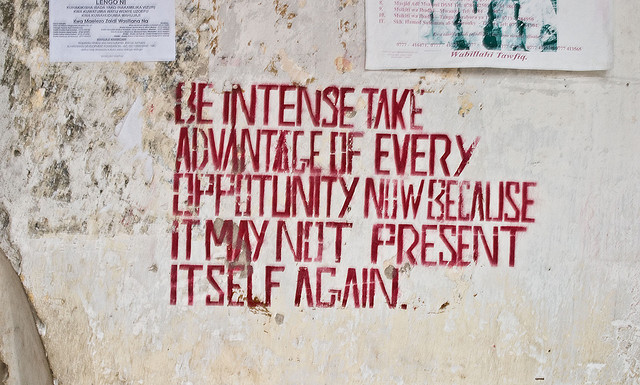
It set me thinking about why I’m so intense about life and so overly aware of lost opportunity.
I came up with four reasons:
1. Saturday mornings(CLICK HERE to read that post.)
2. TV Overdose
3. Death
4. Preparation meets opportunity
I’m skipping over #2 because I’ve been thinking a lot about #3 lately.
Death. What do I mean by that? Let me tell you a story.
On Tuesday, January 12, 1988, Lee, an attorney, went to a meeting at a doctor’s office with Roger, a potential client. Roger wanted Lee to represent him in a medical malpractice lawsuit. The case had been tried before, but Roger had lost. The consult with the doctor that afternoon was intended to help Lee determine if Roger’s claims of medical malpractice were valid. Based on the doctor’s review and opinion of Roger’s medical records, Lee would make a decision to take Roger’s case or decline.
He decided not to take the case.
The meeting concluded and the doctor later recalled hearing Lee say ”Let’s go home and see our children.” Just moments later, as Lee still sat in his chair, putting papers into his briefcase, Roger calmly and quietly pulled out a .25-caliber handgun, put it to Lee’s right temple and pulled the trigger.
Two more shots were fired before the doctor managed to wrench the gun out of Roger’s hand and when Roger tried to run away, the doctor, his body coursing with adrenaline, chased him down and tackled him, pinning him until police arrived. Roger was arrested and just a few weeks later, he tried to end his life by shoving a 6 inch ball point pen 5 inches into his chest and 3.5 inches into his heart. When they found him, he apologized for failing to kill himself.
I didn’t know Roger. I knew Lee.
I was 23 when he was murdered. He had taken a risk hiring a 21 year old college dropout with no legal experience to work as his secretary. I spent 18 months working for him before I quit to go back to school. At that time, he was a sole practitioner, so most of those 18 months, it was just the two of us working alone in a small office. He used to walk around the office in sock feet while the shoeshine guy in the lobby shined his shoes, he would forget to turn off his tape recorder after he finished dictating in the car and would accidently record himself singing to the radio and he’s the only person I ever met who actually did break a tooth by chewing ice. I washed his coffee mug every day, picked up his lunch orders, and accidently saw him in his skivvies when he walked into his garage not knowing I was in there talking to his wife. I was his house sitter, his dog sitter and his baby sitter.
For nearly 18 months, I spent five days a week working in an office alone with that man and I never, not once, shared my faith with him.
Not once.
To this day, when thoughts of Lee enter my mind, they are immediately followed by this one: If that man is in Hell, I had something to do with it.
In those 18 months, I had multiple opportunities to initiate a discussion about faith. It’s not that I wasn’t aware of them. I let each and every one pass.
Because I was 22. I was undereducated compared to him. He was important and he was professional and he was intelligent. And I was intimidated. So I stayed safely silent.
When Lee left his house that Tuesday morning in 1988, it never even crossed his mind that he would be shot in the head at point-blank range by a bitter, 72 year old man. When the doctor greeted his visitors that afternoon, he had no idea that less than an hour later, he would save his own life by wrestling a gun out of someone’s hand. When the paralegal left her routine office job that afternoon to attend a simple meeting, she had no idea she would see her boss murdered right before her eyes. When Lee said goodbye to his wife that morning, she had no idea it would be the last time she ever saw him alive. When he hugged and kissed his two little girls goodnight on Monday, they had no idea it was be the last time they felt their daddy’s arms around them.
When I left that job, I had no idea that my lack of courage would later leave me filled with regret; that my choice to stay within the boundaries of my comfort zone would result in such serious or long lasting discomfort; that I would forever wish that I had said something about my faith in Jesus Christ.
But wishing don’t make it so.
Is it possible that Lee was a Christian and I just never knew it? Sure. But that’s not the point. The point is that I didn’t know. How is that possible? This wasn’t a strained, formal or awkward relationship. I was comfortable talking to him from the moment I met him. My job interview took place in his car while he made an emergency trip to the mall to rescue his wife and baby daughter after she locked her keys inside her car.
It’s just wrong that I knew he wore tighty whities but didn’t know if he knew Jesus Christ. And yes. I do know how weird that sounds, but stay with me people, I’m making a point here.
Time’s a wastin.
We all have opportunities to talk to people about how are lives are different as a result of our relationship with Christ. Every single one of us. Every. single. day. Without exception. But if we aren’t intentional about our choices, those opportunities expire.
Sometimes, we don’t get a second chance.
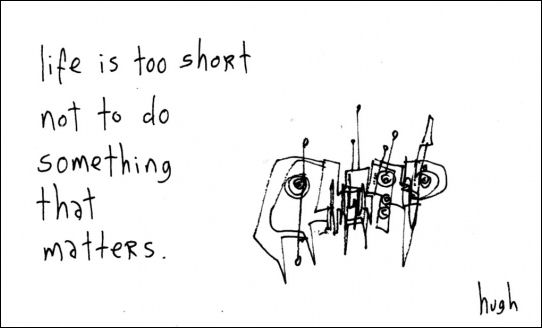
Life is too short to waste it. People are dying every day. People will wake up in the morning and have no idea that it will be their last day on earth – or a loved one’s last day on earth. And too many of us spend this precious gift of time focused on things that fade away. Too many of us slink away from the difficult conversations because it’s easier to talk about “surface” stuff. Too many of us are afraid to look someone directly, maybe even uncomfortably, in the eye and ask, “How are you, really?”
God gives me opportunities to serve Him EVERY day. Every day, multiple times, I choose to ignore Him or obey Him. My prayer is that I choose the latter much, much more often than the former. Because, in the end, after I’ve spent my last day on earth, I’m desperate for God to say “Well done.“
What was something you prayed about that you believed at the time turned out very badly but now, in retrospect, you see was the best thing that could have happened?
Can you see situations in your life where God saved you from a negative consequence or used a bad situation as a foundation for something great? Did someone else share their God story with you?
I want to hear about your blessing in disguise!!!
Comment! Email! If you know me in “real” life, tell me face to face!
. . . when you realize you have nothing to contribute. When you realize everything that can be said has already been said, that there are literally countless people who can do what you’re trying to learn to do – and they are already phenomenally better at it, and that you should give up this fantasy you’re chasing and get back to real life . . .
. . . and then you come to your senses and say, “Get thee behind me Satan! I am so unbelievably sick of you and your lies.”
(this is a re-post from March 2010. writing about seasons of prayerlessness and forgetting God and started thinking about it.)
“Therefore, there is now no condemnation for those who are in Christ Jesus, because through Christ Jesus the law of the Spirit of life set me free from the law of sin and death. For what the law was powerless to do in that it was weakened by the sinful nature, God did by sending his own Son in the likeness of sinful man to be a sin offering.”
Romans 8:1 (NIV)
I was introduced to the writings of Henri Nouwen through the writings of Philip Yancey and I’m finding in Mr. Nouwen a trait I gravitate to in writers: The willingness to be open about their weaknesses and the courage to publicly share their questions about God. When I read authors who allow me to see their confusion and doubt and take me with them, through their writing, to explore the possibilities, I am the better for it. They make me think about things outside my relatively tiny little world. And I believe that God, through these writers, sometimes teaches me what my life looks like through His eyes. Henri Nouwen is a case in point.
Nouwen, in seeking to answer the question, “What do we really desire?” believes the word “communion” seems to best summarize the desire of the human heart:
“Communion means ‘union with.’ God has given us a heart that will remain restless until it has found full communion. We look for it in friendship, in marriage, in community. We look for it in sexual intimacy, in moments of ecstasy, in the recognition of our gifts. We look for it through success, admiration, and rewards. But wherever we look, it is communion we seek . . .”
My favorite coffee mug reads, “That which is good to know is difficult to learn.”
Ain’t it the truth?
Why is this so difficult to learn? Why is it so difficult to remember that these temporary distractions stand in the way of experiencing the communion with God that really satisfies and fills me with the peace of God I crave?
Because I forget God.
And I am not alone. Look at the Israelites. Time and time and time again, they forgot God. And I’m no better. I forget God. And when I do, what do I do? I can stand around paralyzed by guilt and whine about the fact that I forgot Him AGAIN, or I can repent, confess and come back. I choose to hurry up and come back. Time’s a wasting! I don’t want to lose one minute of communion with God because I’m too busy beating myself up for something Jesus died for. This is why God sent His son. He KNEW we would forget. He KNEW we needed Grace.
And I gratefully accept His Grace. So I repent and come back into communion with Him. But I know I’ll forget Him again. And. So. But. Repeat.
C.S.Lewis talked about the fall of man in the book “The Problem of Pain“. He acknowledged that while most of us think of the “fall of man” as an event, something that happened in the Garden of Eden, he also sees the fall of man as something that happens daily. It’s a, sometimes moment by moment, falling away from God’s presence. He wrote:
“at this very moment you and I are either committing it, or about to commit it, or are repenting it.”
Ain’t it the truth?
I can also identify with Jack’s daily determination stay in communion with God:
“We try, when we wake, to lay the new day at God’s feet; before we have finished shaving, it becomes our day and God’s share in it is felt as a tribute which we must pay out of our own pocket, a deduction from the time which ought, we feel to be ‘our own.’
Since I don’t shave every day, I’m wondering how much faster I take my day back than Jack did. Do I claim my day for myself before my feet even hit the floor? I’m thinkin some days – YES.
But by the grace of God, when I remember Him, the immediacy of my repentance and return is prompted by a quote from The Practice of the Presence of God by Brother Lawrence:
“When he had failed in his duty, he only confessed his fault saying to God, “I shall never do otherwise, if You leave me to myself. It is You who must hinder my failing and mend what is amiss.” Then, after this, he gave himself no further uneasiness about it. “(emphasis added)
I’ve forgotten God. I forgot Him yesterday. I forgot Him earlier today. And I will forget Him again. I will fall away from His presence. Again. Even after having experienced the profound peace and contentment from communion with God, I will instead strive after the temporary distractions Henri Nouwen described. But, when I remember HIM again and I recognize my God-given desire for communion with Him, I will come back and by His Grace, I will “give myself no further uneasiness about it.”
What blocks forgiveness is not God’s reticence,
-‘But while he was still a long way off, his father saw him
and was filled with compassion for him’ – but ours.
God’s arms are always extended; we are the ones who turn away.
Philip Yancey What’s So Amazing About Grace?
“There is no neutral ground in the universe; every square inch, every split second is claimed by God and counterclaimed by Satan.” C.S. Lewis
Either I’m on track and Satan is ticked and trying to derail me,
or
I’m off track and God is relentlessly trying to get me to see that He’s answering my prayer for direction.
and so I pray.
because I desperately want to be claimed by God.
I can’t let the negative feedback of man push me to the bench to sit and do nothing, waiting for God to tell me what to do. I can’t let the negative feedback of man discourage me from my ministry, especially after experiencing what I sincerely believe was a powerful interchange of the Holy Spirit with God’s people. I can’t ignore the possibility that Satan is ticked and wants to make sure it doesn’t happen again. Since that big fat liar is no match for the Holy Spirit, he chooses to attack God’s people, planting doubt and sowing discouragement.
I’m going to stay diligent on my path until God slams into me like a linebacker and knocks me off of it.
I’m hardheaded that way.
Not by might, not by power, but by my spirit says the Lord. Zechariah 4:6
(For those who don’t have time to read that post, here’s the twitter version: “passive-aggressive narcissist. boundaries, distance & prayer. attempted normal relationship. failed. back to boundaries, distance & prayer.”)
Back to the question – Have I spoken to this person about their behavior?
The person asking me the question is someone I respect. They deserve an answer with a reason. So here goes.
As Christians, we tend to think God wants us to reek of Ephesians 4 and live in “Unity and Maturity in the Body of Christ.” My concern, the reason I’m still writing about my response to passive-aggressive behavior, is that some Christians interpret “unity in Christ” to mean we should get along with everybody God has placed and/or allowed in our lives. Some Christians believe that “unity in Christ” means that anger is a sin and most importantly, that we should strive to resolve differences when we encounter conflict.
Have I spoken to this person about their behavior? It’s a reasonable question – from a reasonable person. And therein lies the problem. The assumption we want to make is that everyone is, at least for a few minutes of every day, reasonable.
What a beautiful theory.
In reality, it’s more like this:
(oh, chill out. It’s just a cartoon. God loves jerks too.)
To answer the question, Yes. I tried confrontation. I was a communication major. I have a conflict resolution model memorized and am ready to use it at a moment’s notice. So, yes. I did speak with them about their behavior – Before I figured out their standard MO (with everyone, not just me) was passive-aggressive behavior. Specific behaviors were openly addressed and were discontinued, at least temporarily, only to be replaced with a different manifestation of the same root issue. See, passive-aggressive behavior is like a flu strain. It subtly morphs, but is never eradicated. Since the behaviors never stop, the need for attention never ends.
I have years of experience with narcissism and its key characteristic – passive-aggressive behavior. I spent months saturated in research on it. Once I recognized it in this person, I knew exactly what to do. Over and over and over again, the books and documentation suggest that boundaries and distance are the only long lasting solution.
really. I’m not just making this stuff up to avoid confrontation. Remember, I tried confrontation. Confrontation produced temporary results:
“Realize that the narcissist may agree to change the dynamics of the relationship for a short time, to get you off his back,” but will usually revert to what he or she considers “normal.” In the end, the only healthy way to live with a narcissist is to become more of “your own person” and to create a space between you and the narcissist from which you both can live . . .
Minimize direct confrontation with the narcissist’s unhealthy behavior. Most narcissists are simply unable to receive criticism, even if it is meant constructively and spoken in a soft and respectful manner . . .
Maintain good personal boundaries between you and the narcissist. In response to your setting a boundary, the narcissist may attempt to rewrite history or even try to convince you that what you thought (or saw) just happened didn’t, and thus, there is no need for setting a boundary in the first place. Do not back down. . . ” (emphasis added)
My recent problem stemmed from the fact that I intentionally made the decision to take down the boundaries I had set and I attempted to bridge the distance I had established. (To find out WHY I would do such a thing, CLICK HERE to read my post Dear PinkGirl: don’t copy me.
(For those who don’t have time to read that post, here’s the twitter version: “a friend witnessed a passive-aggressive attack that didn’t bother me, but upset her. I explored the possibility that my boundaries were not God’s will.”)
Someone I respected – also a Christian and a reasonable person – witnessed a passive-aggressive attack. Because I had mental and emotional boundaries firmly in place, I bounced back like a quarter on a tightly made bed. My friend, however, was surprised and upset by this person’s behavior. It was new to them and seemed out of character. From my perspective, the behavior was fairly typical. But out of respect for my friend, because it upset her, I decided to prayerfully consider whether I was ignoring any promptings from the Holy Spirit to reach out to the narcissist God was allowing in my life.
Armed with daily prayer and all the research on narcissism and passive-aggressive behavior I could devour, I spent the last few weeks attempting to engage in a positive interpersonal relationship with this person I had previously (and successfully) blocked out for 2 years.
It depleted me. It sapped my energy and stole my peace. It interfered with my work. I became so discouraged I even stopped eating and exercising. I slowly lost my patience and my ability to respond appropriately and began to resent this person and react with frustration when I witnessed continued attempts at manipulation, whereas I had previously felt nothing toward them and had been immune to the manipulation for 2 years. I had experienced 2 years of sincere calm indifference when they behaved badly and now? I wanted to smack ’em every time they acted out. That ain’t good. CLICK HERE to read “step away from the puppy” to read what I wrote about that.”
(For those who don’t have time to read that post, here’s the twitter version: “emotional bullies wear puppy suits. wounded puppy suits. feeding the puppy just makes him hungrier and wipes you out.”)
After relentlessly praying about this situation and this person and relentlessly asking God what he would have me do, I’m grateful and confident that Christ isn’t calling me to extend compassion by making myself available for continuous attack. (again, with another backstory – CLICK HERE to read “I’m going to stop being discouraged and be awesome instead. True Story.“)
(For those who don’t have time to read that post, here’s the twitter version: “I can’t be discouraged anymore. It doesn’t work for me. It’s like breathing through a pillow.”)
My favorite verse in Ephesians 4? Verse 26a: “Be angry but do not sin.”
And I’m very grateful to Dr. Paul Meier for his interpretation of scripture:
David’s response to Saul offers a three-step process for us to follow today: 1. Remember that you aren’t the issue! David knew the problem was with Saul, not with himself. 2. Recognize you can’t cure the other person. David couldn’t straighten Saul out. If you want peace of mind, you must realize you cannot change a crazymaker’s internal workings. 3. We can only change ourselves. Instead of responding to Saul in a like manner, David refused to become Saul’s enemy. David supported the king even as he hid from Saul’s vicious attacks. Crazymakers by Paul Meier M.D.
I’ve gone back to a place of peace through the re-establishment of boundaries, distance and prayer – I literally pray for this person multiple times per week. If anything will change them, it will be God. Because, unlike me, HE can do ANYthing.
CLICK HERE to see other posts I’ve written about dealing with emotional bullies, narcissists and passive-aggressive people.
Inevitably, you come off sounding petty. And a little crazy.
There’s disbelief: “No way. That doesn’t seem like them.”
There’s doubt: “Are you sure? Maybe you misunderstood.”
There’s advice: “You should talk to them about it. They probably have no idea you feel this way.”
And then you think, “maybe I am crazy after all. Maybe I just imagined everything. They seem so normal. So nice.” You look around. “Nobody else has a problem with them. Everybody else thinks they’re nice. There must be something wrong with ME. Maybe I’m tired. or overstressed. oversensitive.”
“Yes, that must be it. This is definitely all in my head. I just need a good night’s sleep. or a day off.”
and then, with the stealth of Eddie Haskel and sweetness of Marie Barone, they strike again.
When you get your bearings, you realize. You weren’t imagining things! You’re not crazy!!! woo hoo!!
wait.
That’s not better. It’s just a different kind of bad. and they’re not going to change. You’re not going to change them.
The only thing you can change is your response.
Someone who engages in passive-aggressive behavior is like a woman sitting in the front row at a play, wearing a big ol’ hat. People approach her and politely tell her that her hat is blocking their view of the stage. They make sure not to insult the hat, assuring her it is a beautiful hat, unique and perfect for her. She smiles and thanks them as they walk away, but she doesn’t take the hat off. She just repositions it to a different spot on her head.
It never even occurred to her to take off the hat.
She’s not being mean. In her mind, she’s not doing anything wrong. Nobody actually asked her to take the hat off. They just told her it was in their way, so she moved it. They told her it was a nice hat. So, by leaving it on, everyone still gets to admire it. She’s doing everyone a great service.
If you’re sitting behind her, you have five choices, only one of them good:
1. You can sit there, mumbling and complaining about the rude woman in the front row wearing the big ol’ hat:
“Can you BELIEVE her? WHAT is her problem?”
2. You can address the issue directly and politely ask her to remove her hat.
But you’re too late. Someone has already told her what a nice hat it is. She’ll defensively tell you that other people have told her they like it, implying that you are a schmuck for asking her to take it off. What’s wrong with you? Why would you even say anything bad about her hat? You must not like her. You’ve hurt her feelings. (You can tell because her bottom lip is quivering.) You’re mean. And after you go back to your seat, just as the show starts, when everyone is supposed to turn off their phone, she’ll send you a text message to tell you that she understands that you’re just upset because you don’t have a hat. After the show, she’ll tell everyone who will listen what happened. Then they’ll all know how petty and mean you were.
Are.
3. You can walk up to her and snatch the big ol’ hat off of her head yourself.
Don’t do it. It just makes you look crazier. and even meaner than if you asked her to remove the hat.
4. You can give up and leave.
What’s the point of sticking around? You won’t be able to see anything anyway.
5. You can STAY and MOVE to BETTER SEAT.
If you’re smart, you’ll move. You won’t let a big ol’ hat run you off.
And if you’re a Christian, you can pray. That she’ll see her big ol’ hat for what it is – an obstacle to open communication and good relationships. Of course, you should probably also pray that God will bless you with the patience and energy to keep moving to a better seat without letting it get to you. (Jesus said we should turn the other cheek. But He didn’t say we had to stand within smack radius.)
New people will come in and, at first, not paying attention, they’ll fill the empty seats around her. After a while, they’ll notice. “That’s a big hat.” They’ll assume she knows it’s rude to leave the hat on. They’ll assume she’ll take it off. When she doesn’t, they’ll find themselves facing the same five choices you did.
As the new people thin out and the crowd consists of people who’ve been there a while, you’ll notice something. She’s surrounded by empty seats.
But she still looks – and feels – good in the hat. And to her, that’s the most important thing.
I know I’m not your “fun” friend. I wouldn’t make a good Bunco buddy. I prefer conversation over television. And without exception, I will choose talking about your goals and ideas and struggles over spending two hours in a dark movie theater not talking at all. I know I’m not the first person you think of when you want to get together with someone and laugh your butt off. I know I’m not one of the friends you invite out for happy hour on girl’s night.
And I’m okay with that.
I would be completely miserable at happy hour.
For me, happy hour is like reading fiction. It’s a diversion from real life. And usually much too loud.
I can’t do it.
(I have my reasons, which I’ll get into in the next few posts, but let me start out by assuring you I’m not like this because I think I’m better than other people. You’ll see. I have “issues.”)
I know I’m different. Some would say, not normal. Some might say annoying. exasperating.
You either get used to me or you avoid me.
But when you need to talk, I’m the friend who wants to have coffee with you. I’m the friend who can handle hearing about the things that keep you awake at night. I’m the friend who wants to hear about the things that keep you awake at night. Without judgement. In confidence. And be prepared for me to pray for you. Right then and there. Out loud and in front of whoever happens to be looking. (well, not so loud I break a confidence)
Sure, we can talk about surface stuff; logistical stuff, like what mechanic we trust, what we love and hate about our phones and data plans, a good (but easy) recipe or maybe even gas prices.
but not for long.
I don’t have a lot of patience for surface talk. It’s like a magazine. Little chunks of uncommitted browsing.
I prefer books. I want to spend a little more time and dig deeper.
While there’s time. Because it’s later than I think.




 “. He acknowledged that while most of us think of the “fall of man” as an event, something that happened in the Garden of Eden, he also sees the fall of man as something that happens daily. It’s a, sometimes moment by moment, falling away from God’s presence. He wrote:
 by Brother Lawrence:




 by Paul Meier M.D.
